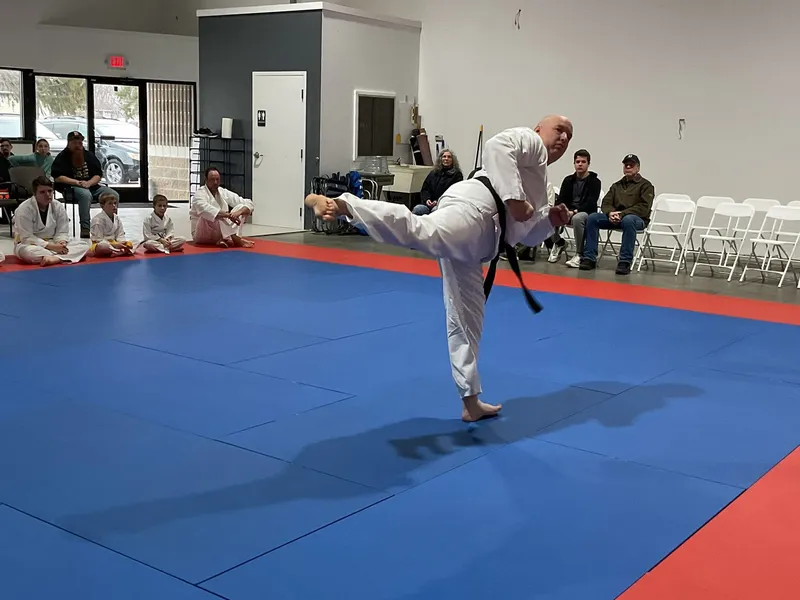
The name itself — 태권도, Tae (foot) + Kwon (fist) + Do (way) — translates as "the way of the foot and fist." But the art is more than that.
Ancient origins.
Taekwondo's roots reach back over 2,000 years, drawing from the ancient Korean martial arts of Taekkyon and Subak. Murals from the Goguryeo kingdom (37 BCE–668 CE) depict warriors performing techniques that clearly resemble modern Taekwondo forms.
Through the Three Kingdoms Period, the Silla dynasty's Hwarang warriors codified the practice, combining physical skill with a strict ethical framework — loyalty, filial piety, trust, courage, and justice. These values still shape Taekwondo instruction today.
The modern era.
After the Korean War, nine kwans (schools) emerged across Korea, each with distinct variations of Korean martial arts. In 1955, under the leadership of General Choi Hong Hi, these kwans unified under the single name "Taekwondo" — a deliberate choice to honor the art's ancient Korean lineage.
The Kukkiwon (World Taekwondo Headquarters) was established in 1972, standardizing ranks, curriculum, and forms. Taekwondo became an official Olympic sport in 2000.
Why we teach it.
At BT Martial Arts, we teach traditional Taekwondo — not competition Taekwondo, not the sport-Olympic variant. That means forms matter. Stances matter. Respect matters. Bowing in and bowing out matters.
Modern martial arts are easily reduced to fighting technique. We resist that. Taekwondo is a practice — something you grow into over decades, not a year. The physical skills are real, and the self-defense is real. But the point is the person you become through the practice: more disciplined, more observant, more calm, more present.
"The real value of Taekwondo is what it does to the character of the student — not the student's ability to break a board." — Master Bryn
The five tenets — and what they look like in class.
Every belt-ranking test in Taekwondo references these. Every class opens by honoring them. They're the scaffold the physical practice hangs on — and every time your child steps on the mats, they're practicing them.
- 01Courtesy — carry yourself with respect for everyone around you. In class: bowing in and bowing out, addressing instructors as "Sir" or "Ma'am."
- 02Integrity — do what's right when no one is watching. In class: practicing forms correctly at home, even when no one will check.
- 03Perseverance — keep training through plateaus, hard days, and doubt. In class: showing up on the days you don't feel like it.
- 04Self-control — the ability to hold your power in check is what makes it meaningful. In class: controlled contact in sparring, walking away from schoolyard conflict.
- 05Indomitable spirit — unbreakable resolve in the face of difficulty. In class: testing for the next belt, even after failing once.
By the end of two weeks on the mats, you'll start to see it: your child listens on the first cue, stands a little taller, handles frustration differently. That's the tenets working.